
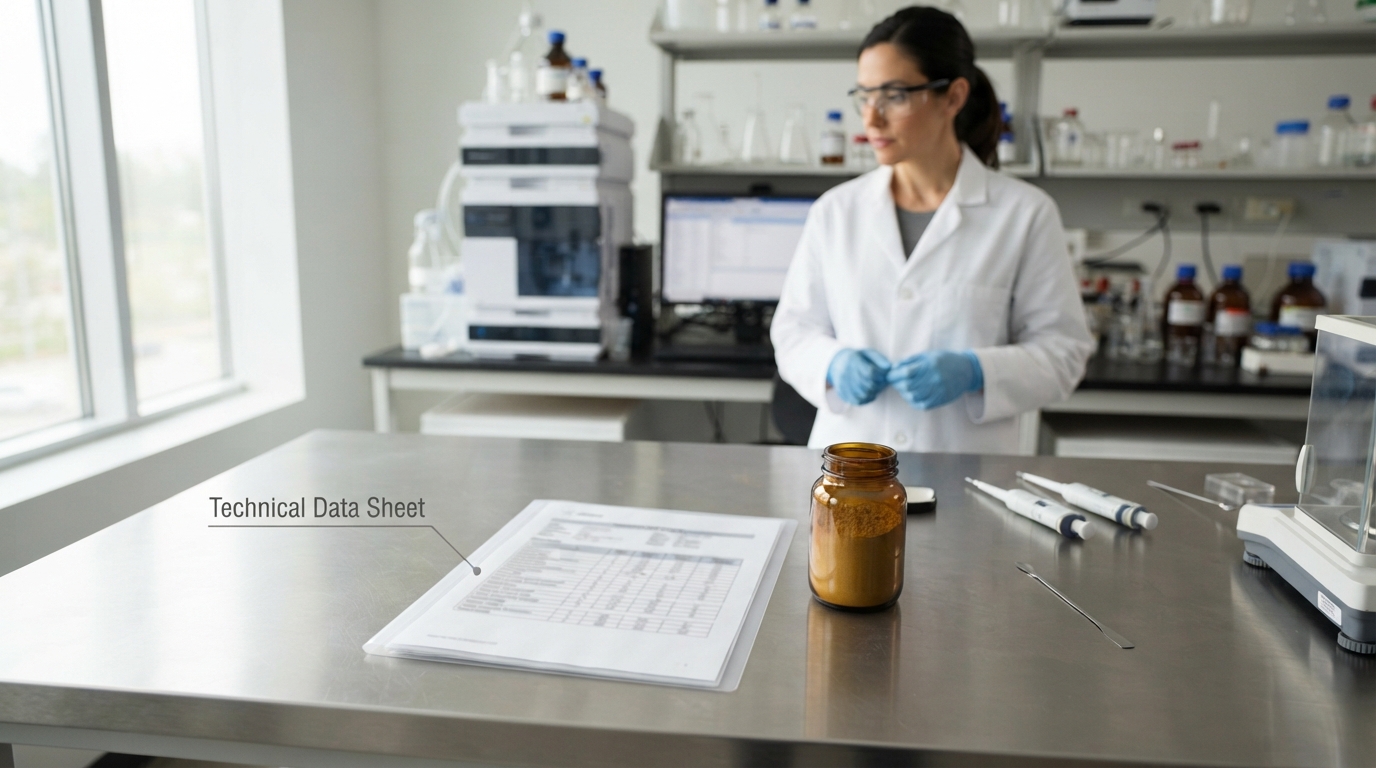
A botanical extract technical data sheet (TDS) is a supplier document that describes an ingredient’s identity, source, composition or standardization, physical and chemical specifications, analytical methods, storage, and shelf life. It is not a batch-specific certificate of analysis; it gives you the baseline you need to evaluate one ingredient, compare suppliers, and plan your formulation work.
This article explains what belongs in a botanical extract TDS, how it differs from other supplier documents, and how to review it before you approve an ingredient for supplements, foods, beverages, or cosmetics.
Why a Botanical Extract TDS Matters in Ingredient Sourcing
A technical data sheet is usually the first technical document a supplier shares with a potential buyer. It is not a sales brochure. It is supposed to tell you what the ingredient is, how it is made, what specification it is expected to meet, and how it should be handled.
For a formulator, the TDS provides the information needed to judge whether an extract can work in a specific product: Is it a powder or a liquid? Is it water-soluble? What marker compound is standardized? What storage conditions are required? For a procurement or quality professional, the TDS creates the reference point against which batch-specific documents can be checked.
Without a clear TDS, routine decisions become difficult. A formulator cannot confirm solubility expectations. A quality team cannot compare one lot to another. A buyer cannot easily tell whether two suppliers are offering equivalent materials. The TDS matters because it turns a vague ingredient description into a measurable set of expectations.
What Is Normally Included in a Botanical Extract Technical Data Sheet?
No single universal template exists for botanical extract TDS documents, but the most useful ones cover the same core areas. The table below shows the fields that appear consistently across supplier documents and technical-dossier guidance.
| Section | Typical Data | Why It Matters |
|---|---|---|
| Product identity | Product name, common name, botanical name, plant part | The botanical name removes ambiguity between species, and the plant part can change the extract’s composition |
| Source and origin | Country or region of origin, supplier reference | Supports traceability and helps you assess supply-chain risk |
| Extraction and production | Extraction method, solvent, carrier or excipient if used | Can affect solubility, composition, and questions about residual solvents |
| Standardization / active marker | Declared marker compound and target range | Tells you what the extract is standardized to, not just what plant it came from |
| Analytical method | HPLC, UV/Vis, or another method | The same marker can produce different results depending on how it is measured |
| Physical description | Appearance, odor, physical form | Provides a quick visual check when material arrives |
| Particle size / mesh | Mesh size or micron range, if supplied | Affects flow, mixing, and dispersion in some applications |
| Moisture content | Percentage or maximum limit | High moisture can affect stability, caking, and microbial risk |
| Solubility / pH | Water-soluble, oil-soluble, dispersible, pH behavior | Often determines whether an extract can fit a beverage, capsule, or cosmetic formula |
| Packaging and storage | Recommended container, temperature, light, humidity | Tells you how to protect the material after receipt |
| Shelf life | Duration under defined storage conditions | Helps with inventory planning and supplier qualification |
| Related documents | Batch number, CoA, SDS, specification sheet | Connects the TDS to the documents needed for batch approval |
Some suppliers include additional information such as microbiological limits, heavy-metal limits, pesticide residues, or residual solvents. Those details may appear in the TDS or in a separate specification. When they are missing, you should ask whether they are available in another document.
The terms suppliers use are not always consistent. What one company calls a TDS, another may call a plant extract specification sheet. Compare the content, not just the document title.
Technical Data Sheet vs. Certificate of Analysis vs. Safety Data Sheet vs. Specification Sheet
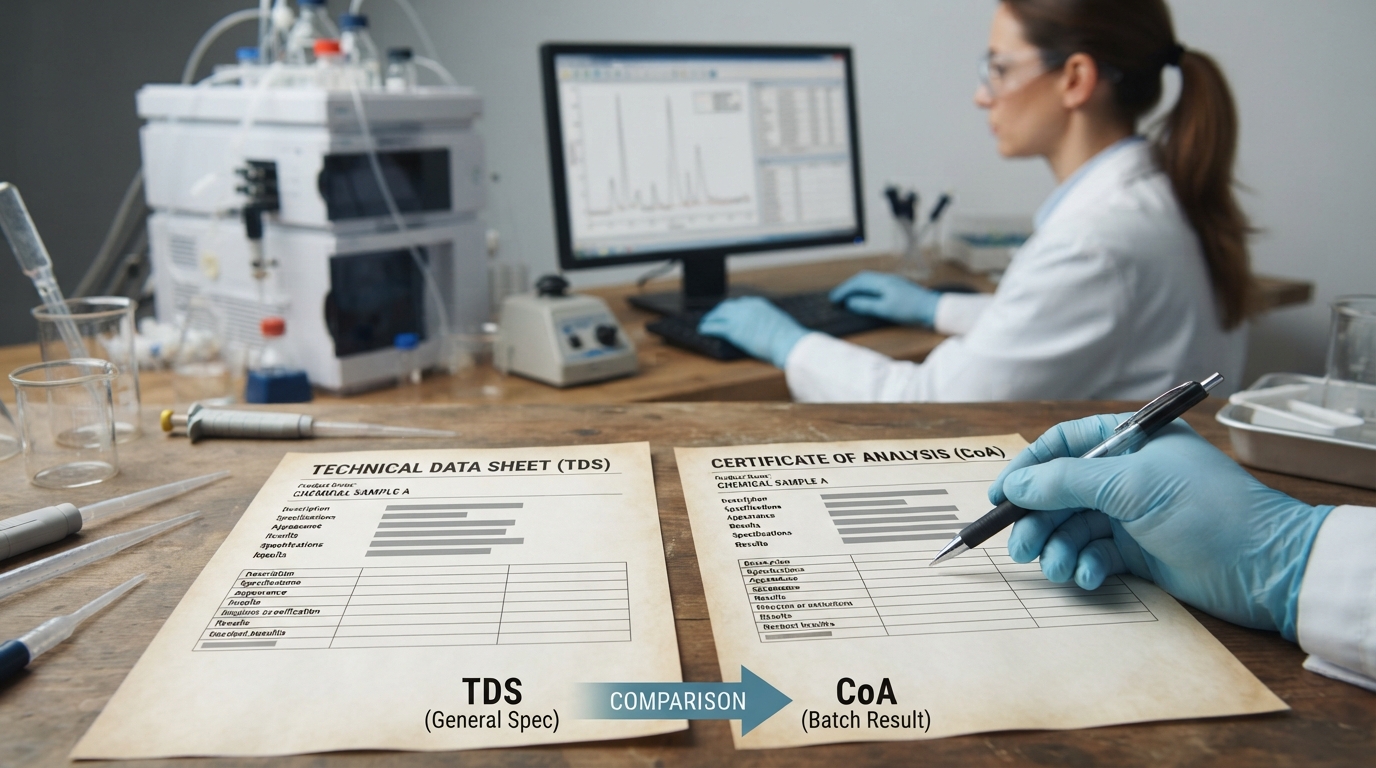
Buyers often use the terms TDS, CoA, SDS, and specification sheet as if they were interchangeable. They are not.
| Document | Main Purpose | Typical Contents | When to Request It |
|---|---|---|---|
| Technical Data Sheet (TDS) | Describes the ingredient and how it should be handled | Identity, source, specifications, physical properties, storage, shelf life | During initial supplier qualification and formulation planning |
| Certificate of Analysis (CoA) | Reports actual results for a specific batch | Batch number, test date, results, acceptance limits, method references | With every batch, before release or use |
| Safety Data Sheet (SDS) | Communicates hazards and safe handling information | Hazards, exposure controls, transport information, emergency measures | When the material is classified as hazardous or when safety documentation is required |
| Specification Sheet | Defines target requirements and acceptance criteria | Physical, chemical, and microbiological limits | When you need a clear pass/fail reference for raw-material testing |
A TDS is a general technical profile. A CoA is batch-specific evidence. An SDS is a safety document. A specification sheet is a set of acceptance requirements.
Trade-development guidance for ingredient suppliers also separates these documents by function, so it is reasonable to expect a professional supplier to provide all four when needed.
How the TDS and CoA Work Together
Think of the TDS as the ingredient’s technical profile and the CoA as the proof for one lot. The TDS might state that a standardized extract should contain a minimum level of a marker compound. The CoA shows what that specific batch actually contained. You normally need both: the TDS to understand the product, and the CoA to verify the batch.
If the CoA results fall outside the range described by the TDS or specification sheet, ask the supplier to explain the discrepancy before the material is approved.
Potency Percentage, Purity, and Extract Ratio: How to Read the Numbers Correctly
One of the most common sourcing mistakes is treating an extract ratio as if it were a potency value.
For example, a 10:1 extract means that roughly 10 parts of starting plant material were used to produce 1 part of extract. It does not tell you how much of any active compound is present. Two different plants, or two different batches from the same plant, can both be labeled 10:1 while containing very different levels of a specific marker. As a peer-reviewed article on botanical extracts explains, plant-to-extract ratios can be misinterpreted, especially when carriers or excipients are included in the final product.
Potency is usually expressed as a percentage of a declared marker compound. A product described as “20% ginsenosides” is expected to contain 20% of those marker compounds by weight, or 200 mg per gram, depending on how the assay is reported. That kind of standardized value is more useful for formulation consistency than an extract ratio alone.
| Term | Example | What It Means |
|---|---|---|
| Potency / standardization | “20% marker compound” | The extract is expected to contain a defined amount of the stated marker |
| Extract ratio | “10:1” | Describes the relationship between starting plant material and the resulting extract |
| Purity | “95% pure” | Can refer to assay content or absence of impurities; the meaning must be confirmed |
| Assay method | “HPLC” or “UV/Vis” | The analytical method used to measure the marker; different methods can give different answers |
Purity is another term that needs context. It can mean the amount of a specific compound in the extract, or it can mean that the material is free from contaminants and adulterants. The TDS should make this clear. If it does not, ask the supplier which definition applies.
The analytical method also matters. HPLC and UV/Vis are both used for botanical testing, but they are not interchangeable. Reference standards and validated methods are central to reliable botanical analysis, so the TDS should identify the method behind the listed specification.
Why the Details Matter for Your Application
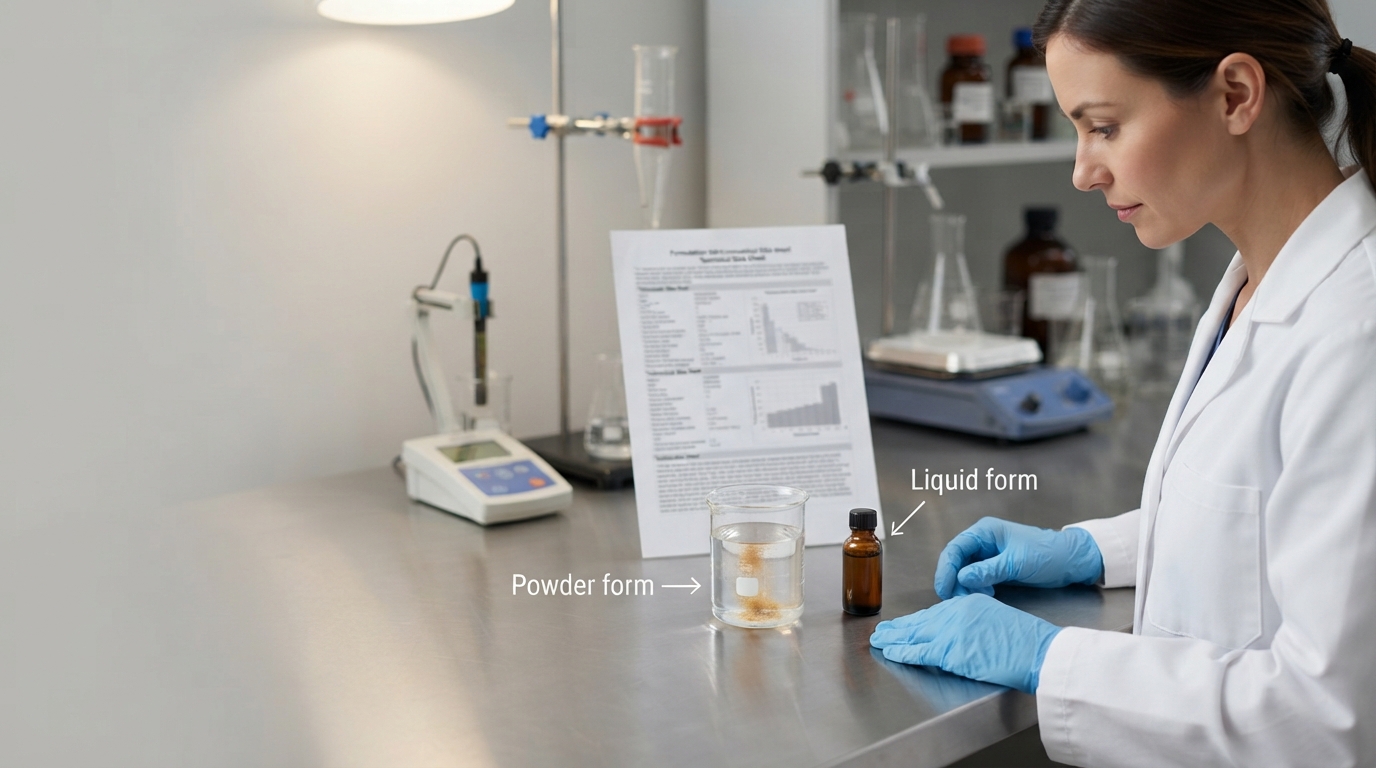
The same extract can look good on paper but fail in your actual product if the physical properties do not fit the application.
| Application | Most Important TDS Fields | Why They Matter |
|---|---|---|
| Capsules and tablets | Particle size, moisture, flow, assay | These factors affect fill weight, tablet compression, and batch consistency |
| Beverages | Solubility, pH, taste, clarity | Poorly soluble extracts can cloud a drink or settle out over time |
| Functional foods | Form, moisture, color, flavor | Processing conditions and sensory impact can make a technically good extract unusable |
| Cosmetics and skincare | Carrier, solubility, stability, appearance | The extract must be compatible with the emulsion or finished formula |
A powder that dissolves well in water may be ideal for a beverage but less convenient for a tablet. A liquid extract may be easy to dose into a cosmetic formula but harder to use in a dry supplement blend. Reading the TDS with your application in mind helps you select the right form before you invest time in samples.
What a Technical Data Sheet Cannot Prove
A TDS is a useful starting point, but it has limits. It should not be treated as proof that a specific batch meets specifications.
- A TDS does not prove that a particular batch passed its tests. Only a current CoA can do that.
- A TDS does not prove that a supplier is certified. Certifications such as GMP, ISO, or USDA Organic require separate evidence and should be checked against the actual scope of the certificate.
- A TDS does not replace an SDS. If you need hazard information for transport, storage, or workplace safety, request the SDS separately.
- A TDS does not guarantee batch-to-batch consistency. That claim must be supported by production records, testing results, and a reliable quality system.
If you are still building your supplier evaluation process, it helps to know what certifications should i look for when sourcing plant extracts and how can i check the quality of a standard herb extract before you move too far into sampling.
Checklist: How to Review a Botanical Extract Technical Data Sheet
Use this checklist when a supplier sends you a TDS for the first time.
- Confirm the botanical identity. Check the botanical name and the plant part. Common names alone are not specific enough.
- Check the specification. Look for the declared marker compound, the target value, and the unit used. Is it a percentage, a ratio, or a concentration?
- Identify the analytical method. Make sure you know whether the value comes from HPLC, UV/Vis, or another method.
- Review the physical properties. Compare particle size, moisture, solubility, and form against your application requirements.
- Confirm storage and shelf life. Check whether the recommended conditions match your warehouse and production environment.
- Request the batch-specific CoA. The TDS tells you what the product should be; the CoA tells you what the batch actually is.
- Ask for the SDS if needed. If your team handles the material, safety documentation should be available before receipt.
- Request clarification for missing fields. A missing specification is not always a problem, but you should know why it is missing and whether the data exists elsewhere.
Frequently Asked Questions About Botanical Extract Technical Data Sheets
Does a botanical extract technical data sheet expire?
A TDS is tied to the ingredient’s current formulation and specification. If the product changes, the TDS should be revised. The ingredient itself still has a defined shelf life under the stated storage conditions. Check both the document revision date and the product shelf life when you qualify a supplier.
Why do different suppliers use different document names?
Document naming is not standardized across the botanical extract industry. One supplier may call the same document a TDS, another may call it a specification sheet, and a third may provide a product data sheet. Compare the content and the specifications rather than relying only on the title.
Can I request a TDS before placing an order?
Yes. A TDS should be available before you commit to a product. In fact, requesting the TDS and a batch-specific CoA during initial qualification is a normal part of B2B ingredient sourcing.
What should I do if the TDS and CoA seem inconsistent?
Ask the supplier for clarification before you approve the batch. The TDS may describe a target range while the CoA reports actual results. If the discrepancy is significant, request a revised CoA or ask the supplier to explain the test method and acceptance limits.
When you request documentation for an ingredient, make sure you receive both the current TDS and a batch-specific certificate of analysis. The first tells you what the supplier intends to deliver; the second tells you what was actually delivered. Together, they give you a practical basis for approving a botanical extract with confidence.

